The Muckleburgh Mural
Stretching an impressive 40 feet wide and 11 feet high, The Muckleburgh Mural features eye-catching depictions of different British Tanks throughout history. It is a visual journey through more than a century of armoured warfare, charting Britain’s tank development from its tentative First World War beginnings to the cutting-edge main battle tanks of the modern era.
Painted in 2012 by military artist and former Parachute Regiment soldier Eddie Goodridge, the mural took an extraordinary 313 hours to complete. Using a combination of acrylic and oil paints, Goodridge - a local North Norfolk based artist - places eight of the most significant British tanks centre stage, with atmospheric backdrops that subtly evoke the conflicts and landscapes in which they fought.
Continue reading as we deep dive further into the background of the iconic Muckleburgh Mural…
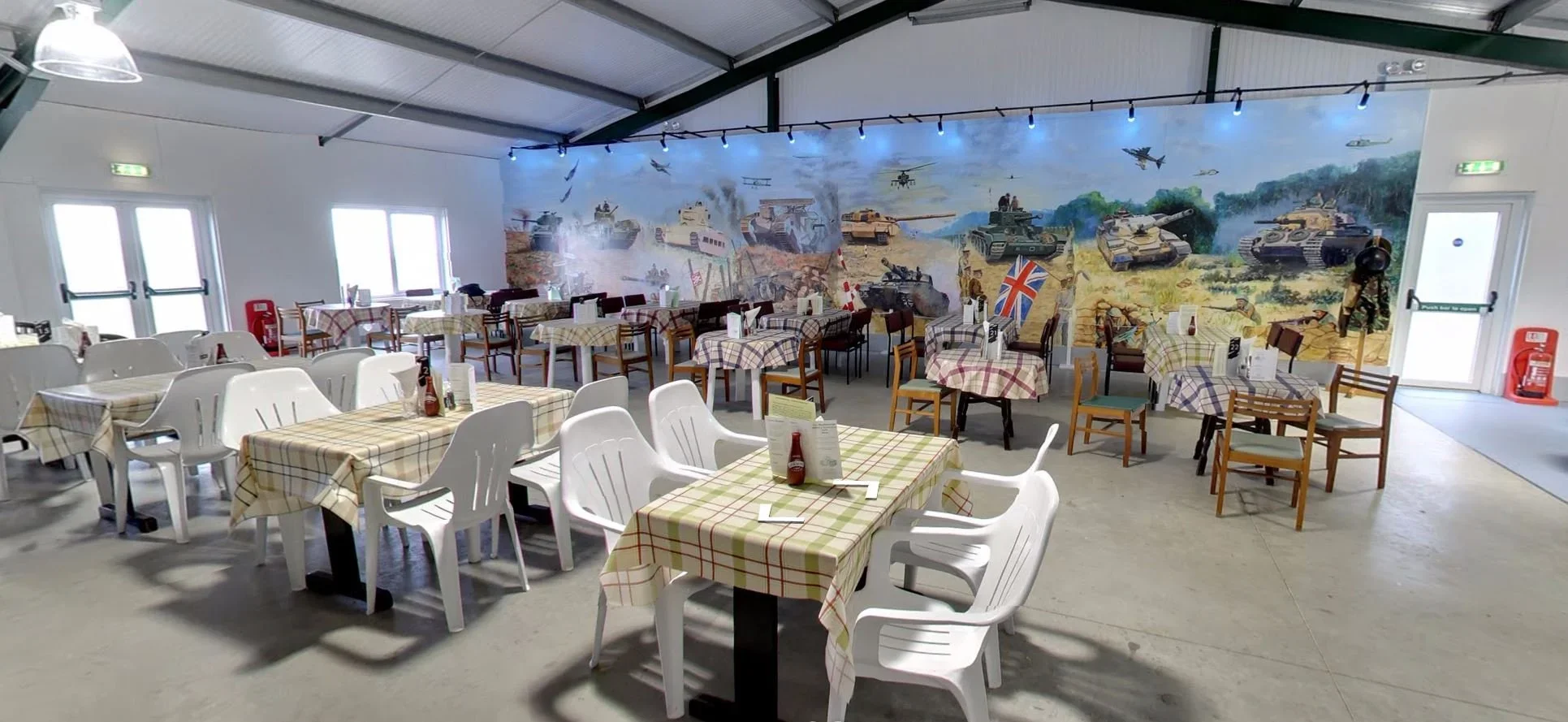
We begin with reference to the Mark IV tank which was first used one hundred years ago with limited success during the Battle of the Somme on 15th September 1916. The improved Mk V, depicted in the middle of the mural, made its combat debut at the Battle of Hamel in July 1918 and penetrated the German lines at the Battle of Amiens in August 1918 - a foretaste of modern armoured warfare. The first tank which had been developed back in September 1915 and was known as “Little Willie”, to mock the German Imperial Crown Prince Wilhelm.
The Mark V shown is a “Male” tank, armed with 57mm guns mounted in side sponsons. Its roof-mounted unditching beam is a reminder of the formidable obstacles it faced: trenches, shell holes, and barbed wire. With a top speed barely faster than walking pace, these tanks nevertheless laid the foundations of modern armoured warfare.
Moving left through the mural, the pace of technological change accelerates with the approach of the Second World War. One can notice the Mark 2 Maltilda tank, famed for its thick armour, proved devastating during Operation Compass in North Africa in 1940, shrugging off Italian anti-tank fire. Though later outmatched by German guns under Rommel, it remained an effective infantry support tank and holds the unique distinction of being the only British tank to serve throughout the entire war.
Beside it stands the formidable Churchill tank, renowned for its ability to survive punishment that would destroy most vehicles. Its heavy armour and remarkable climbing ability made it invaluable in terrains ranging from the deserts of North Africa to the hills of Italy and the bocage of Normandy. The Churchill’s versatility spawned numerous specialised variants, including flamethrowers and bridgelayers – one of which can be seen undergoing restoration at The Muckleburgh Collection today!
At the far left, the Sherman Firefly represents British ingenuity under pressure. By mounting the powerful 17-pounder gun onto an American Sherman chassis, British forces finally gained a tank capable of taking on German Panthers and Tigers in Normandy. Though Fireflys were few, their impact was decisive.
On the opposite side of the mural, the post-war era comes into focus. The Cromwell tank, famously inspected by Sir Winston Churchill, brought speed and manoeuvrability to the battlefield in 1944. Powered by the Rolls-Royce Meteor engine – derived from the Merlin engine of Spitfire fame – it could outflank heavier German tanks, even if its firepower required continual improvement.
The leap into the Cold War is marked by the legendary Centurion, one of the most successful tank designs of all time. Entering service during the Korean War, it went on to serve across the globe, from Vietnam to the Middle East. Constantly upgraded, it set the standard for the modern main battle tank.
Following it is the Chieftain, a Cold War powerhouse armed with a devastating 120mm gun. Among the most advanced tanks of its day, it saw extensive combat during the Iran-Iraq War and remains in service with several nations today.
At the centre of the mural once more is Britain’s current main battle tank, the Challenger 2. With its revolutionary Chobham (Dorchester) armour, advanced suspension, and rifled 120mm gun, it represents the pinnacle of British tank design. During the 2003 Iraq War, Challenger 2 achieved an unmatched combat record, destroying enemy tanks at extreme ranges without suffering a single loss.
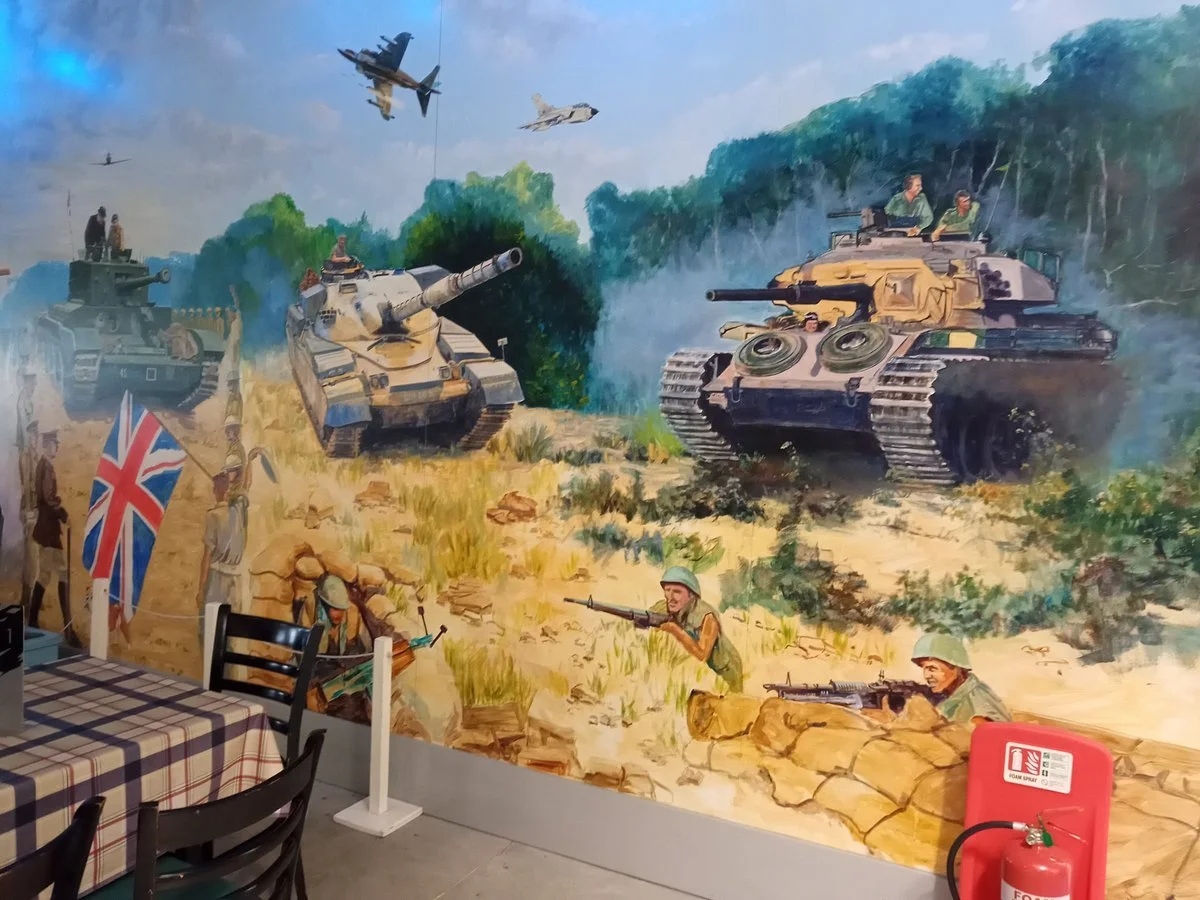
What makes the Muckleburgh Mural especially compelling is also of course the artist behind it. Eddie Goodridge served for 15 years with the 3rd Battalion, the Parachute Regiment, including time in an anti-tank platoon. His firsthand understanding of military life really does bring authenticity and respect to every brushstroke and we will be forever grateful for his talents and creativity.
Today, the mural stands as a centrepiece of The Muckleburgh Military Collection situated in our cafe, perfectly complementing the historic vehicles on display. It invites visitors not just to look, but to reflect on how technology, courage, and necessity have shaped over a century of British armoured warfare throughout time.
Next time you visit, take a moment to stand back, trace the tanks across the mural, and watch history roll past you, one track at a time and see what you can then spot during your visit of our collection!